



ESSENTIAL NOTES ABOUT THIS MUSHROOM
Cordyceps is a celebrated functional mushroom naturally rich in bioactive biomolecules, including beta-glucans, ergosterol (provitamin D), essential amino acids, and linoleic and linolenic essential fatty acids. Most notably, its high concentration of cordycepin, alongside cordycepic acid and adenosine, creates a unique profile of high functional value and profound scientific interest. The diverse traditional applications of this fungus have led the global scientific community, and our own R&D team in particular, to study it extensively.

DOCUMENTED USES OF CORDYCEPS
C. sinensis is not a traditional culinary mushroom that is prepared like Shiitake or Boletus. Due to its naturally firm consistency, it is typically consumed in concentrated extract capsule form—such as Mico-Cord or Hifas-Vitality—or as a dehydrated, micronised powder (Cordyceps Vital). Traditionally, the dried mushroom is also used as an aromatic condiment in soups, stews, and vegetable dishes.
Quality and Purity
Like other pure mushroom powders, organic Cordyceps powder (Cordyceps Vital) can easily be stirred into warm infusions or blended into healthy smoothies. However, the highest concentration of bioactive compounds is achieved through concentrated extracts produced with green, low-temperature extraction technologies that preserve biomolecular integrity. This advanced process is used in formulas such as HIFAS-Equilibrium, which features pure biofermented C. sinensis extract alongside complementary species.
Products with cordyceps
-


Cordyceps Vital Powder Superfood
THE BENEFITS OF THE ENERGY MUSHROOM
£26.00( £26 / 100 g )Unit price /Unavailable -

 TOP SELLERSHasta - 10 %
Mico Cord (Cordyceps Extract) Capsules
NATURAL ENERGY BOOST
From £54.00( £0.9 / Capsule )Unit price /Unavailable


CORDYCEPS CULTIVATION
Thanks to advances in fungal biotechnology, specific strains of Cordyceps can now be cultivated in state-of-the-art bioreactors. This controlled liquid fermentation process utilises a 100% natural liquid substrate to yield high-purity Cordyceps mycelium, offering a bioactive profile equivalent to that of wild fruiting bodies while ensuring maximum sustainability and consistency.
Featured Biomolecules
The highest quality concentrated active biomolecules are found in the composition of Cordyceps sinensis, such as:


Do you want to know more?
Habitat and distribution
Habitat and distribution
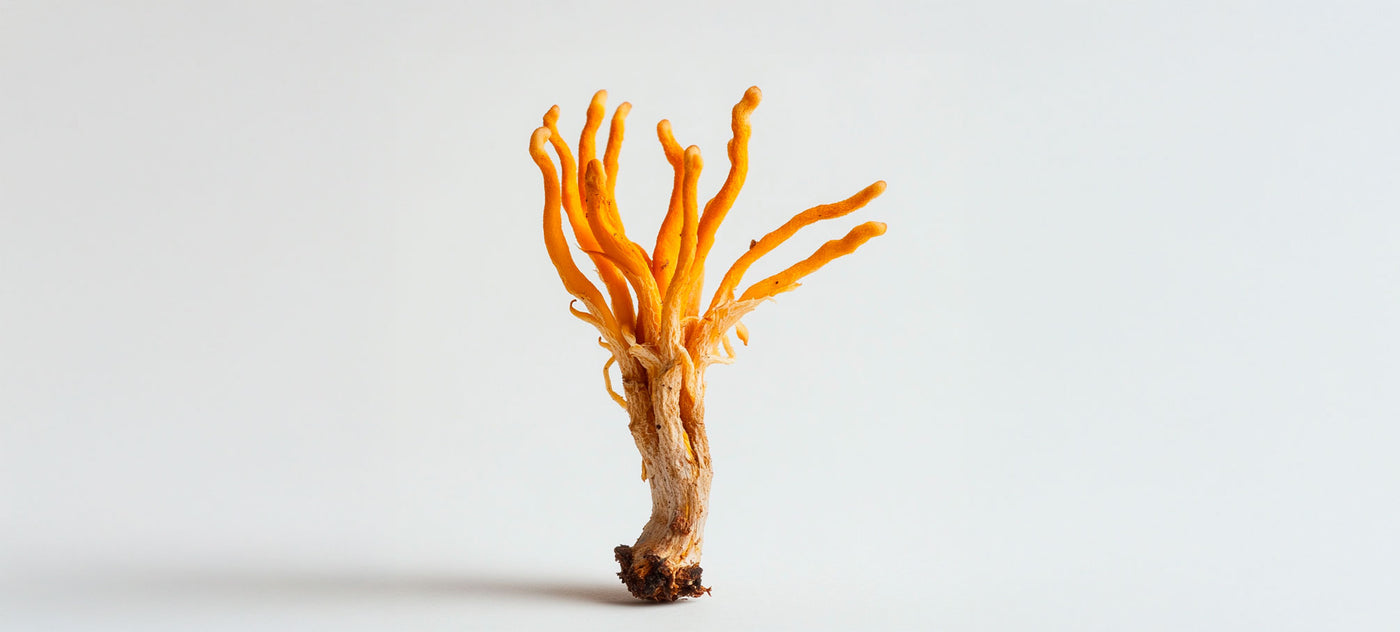
Wild Cordyceps is found exclusively in the high-altitude Himalayan region, thriving at elevations between 3,000 and 5,000 metres across Tibet, Bhutan, China, and Nepal. In nature, C. sinensis grows individually rather than in clusters, developing parasitically on ghost moth caterpillars. Due to high global demand and extreme geographical limitations, wild Cordyceps remains one of the world's most costly raw materials—traditionally valued higher than gold by weight.
Because wild specimens are harvested by hand and traded by weight, unverified market sources carry a risk of adulteration or contamination with heavy metals such as lead. While wild Cordyceps holds a long-standing place in Asian botanical traditions, ensuring safety requires strict testing. At Hifas da Terra, our indoor bioreactor cultivation and standardised extraction protocols completely eliminate contamination risks, guaranteeing pure, heavy-metal-free formulas with batch-tested bioactive concentration.
Mycological notes
Mycological notes
Cordyceps sinensis, together with Reishi and Lion's Mane, is one of the most popular natural remedies.com/hongos-medicinales/melena-de-leon-hericium-erinaceus/">Lion's mane, is one of the most popular natural remedies in traditional Asian medicine. According to the volume Wild Edible Mushrooms – Global Outlook on Their Use and Importance for People published by the FAO, this mushroom is ‘eaten’ solely for its nutritional value. It grows naturally on the high plateaus of Tibet and has been harvested intensively for years in areas of China, Bhutan and Nepal. In fact, Cordyceps is hugely important economically, especially in Tibet. Parts of the population are completely specialised in collecting wild specimens and are therefore dependent on the development of the fungus population. It is estimated that the collection and sale of Cordyceps accounts for 20-30% of Tibet's agricultural products.
The culture in bioreactors
The culture in bioreactors
Maximum quality, purity and potency in our production systems
One of thelines of research at Hifas da Terra is focused on the continuous improvement of the cultivation of different species in bioreactors (Reishi, Lion's Mane, Shiitake and Maitake) using certified organic substrates, as well as on the standardisation of the quality of the ingredients of origin to guarantee excellence in the final product developed with each mushroom. Hifas Quality System we identify biomolecules and active ingredients, we carefully select the fungal strains that contain them, we use our own specific analytical systems, and we apply analysis protocols at different stages of production. Thanks to this rigorous system, we offer natural products, supplements and nutraceuticals with the Hifas Quality System guarantee, setting us apart from other products in terms of purity and premium quality.
R&D and cordyceps studies
R&D and cordyceps studies
In Hifas da Terra we carry out studies with all the fungi we grow that evaluate the quality of extracts and their use.
Curiosities
Curiosities
- The cordyceps jumped to the headlines in the 1990s. Thus, the Chinese athletes beat world records in the World Athletics Championship of Stuttgart and the National Games of Beijing. Then the entire world discovered cordyceps as a supplement.
- The «Functional properties» From this fungus they are related to the grazing of Tibet. With the arrival of spring and the first thaws, the shepherds climbed with their cattle to the high areas of the mountains so that they could feed. After ingesting brown grass (cordyceps), yaks, goats and sheep had a behavior similar to that of Épocas of heat.
- Some species of cordyceps (Cordyceps militaris) They also grow in our latitudes. The C. militaris is also produced by biotechnology and, once dry, it is usually added to soups and stews. Its components are very similar to those of C. sinensis. However, to know what they are and their concentration we must acquire quality products with a standardization of active biomolecules.